Brennan will reach a significant milestone in water treatment operations this year: treating our five-billionth gallon of water. We expect to reach this landmark in October 2026, and as soon as we do, we will charge straight past it.
We tally the gallons every day as we complete water treatment scopes for environmental dredging projects across the country. The total includes water from waterways throughout the Great Lakes Basin and along the Eastern Seaboard, including Lakes Michigan and Superior.
How much water is five billion gallons? It certainly sounds like a big number, but to the people responsible, it is much more than a meter ticking up as water rushes through a pipe. Five billion gallons represents the work of dedicated people doing something different, meaningful, and challenging. It represents trial and error, hard days, and setbacks. It represents forging ahead through change. It represents taking chances, acting with integrity, and daring to think outside the box.
The Beginning
Brennan’s story in water treatment begins in Michigan with Infrastructure Alternatives, Inc. (IAI). In 2001, Bill Cretens founded IAI with a vision to provide the best contract operations services to municipal water and wastewater utilities. But he also saw potential in a newer technology: geotextile tubes used to dewater sediments and sludges.
I recall Bill saying that separating solids and water is what water and wastewater operators do every day. With his typical enthusiasm, he would add that, of course, they would be great at applying this technology. That thinking soon led IAI beyond traditional water and wastewater operations and into sediment remediation.
After completing several small lagoon sludge-dredging projects, IAI broke into the environmental remediation market with a subcontract to provide hydraulic dredging, geotextile tube dewatering, and water treatment for the Black River Mill Pond remediation in Bangor, Michigan. With that, we were off and running.
Opportunities came in fits and starts, but the team led by Bill and Paul Stage (now a Brennan senior director) continued to build experience and knowledge, applying tried-and-true wastewater treatment techniques to sediment remediation.
Like projects, connections didn’t form immediately, but as IAI built working relationships, we found new directions we never imagined alone.

The Partnership
As IAI built experience in sediment remediation, a new relationship began to take shape. In 2004, IAI landed a dewatering and water treatment pilot study on Fox River Operable Unit 1 (OU1), working side by side with a dredging contractor it had never worked with before: Brennan. From the beginning, it was clear that the leadership and teams from both companies worked well together and shared a commitment to excellence.
Paul said, “In the early years, we didn’t give much thought to the total gallons treated. We were focused on integrating dredging, dewatering, and water treatment into a reliable, high-production operation. Just when we thought we had mastered the current production goal, we would increase production on the next project. The dewatering and water treatment group’s mission was simple: Don’t become the bottleneck.”
In the years that followed, Brennan used IAI’s Dredging & Dewatering Division as a preferred subcontractor on many environmental remediation projects. Even when contracted separately, Brennan and IAI communicated and planned their work as a team, strengthening their partnership over time.
In 2023, we made it official: Brennan acquired IAI’s Dredging & Dewatering Division, and we became one team. The acquisition meant saying goodbye to colleagues on IAI’s municipal side and growing capabilities in treatment system design, treatability, operator certification, permitting, and reporting.
Through the years and many changes, a few projects stand out.

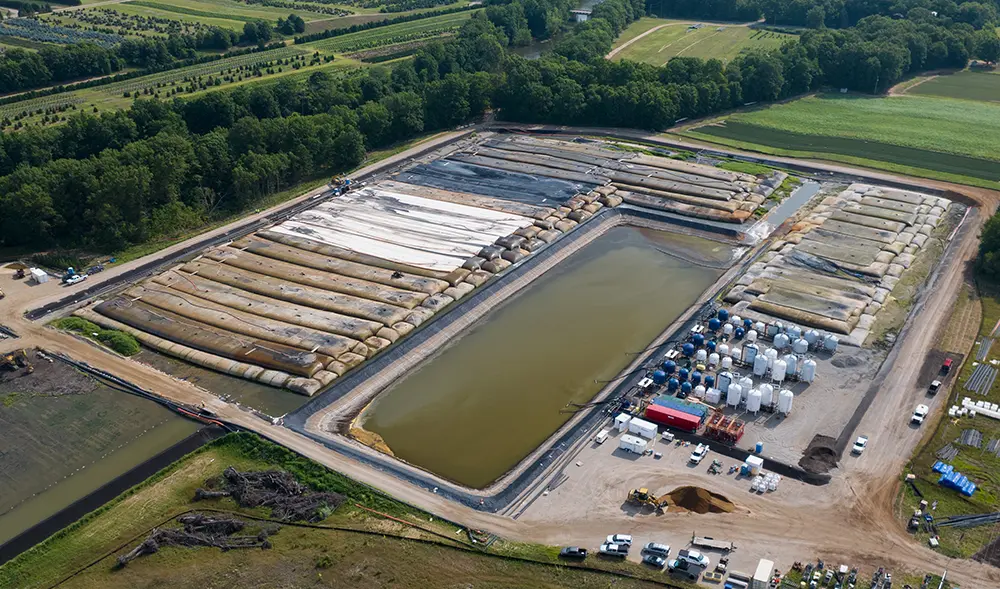
Geotextile Tube Dewatering | Ottawa River – Toledo, OH
The Projects
Mill River Remediation
Mill River Remediation, our first water treatment project that did not involve polychlorinated biphenyls (PCBs) as a contaminant of concern, was also one of our biggest successes. The team dredged lead-impacted sediment from the site, where Brennan operators first used in-pipe chemical treatment to neutralize hydrogen sulfide odors.
General Superintendent Jerry Bishop recalls, “We faced some difficult challenges, including a small footprint, tight discharge limits, pH adjustments to remove metals, and limited staff experience with this type of treatment system. But throughout the project, we found solutions to keep our discharge in compliance.”
Ottawa River
Paul reflects on the Ottawa River project as a key success story: “It stands out. Before that project, we were on a steep learning curve and experienced several painful lessons involving proper polymer make-down and application, optimal polymer dosing, and water treatment plant design and capacity. Because we were involved early in the design of the Ottawa River project, we were able to apply those lessons, address many of the earlier challenges, and develop a much more effective operation.”
Spirit Lake Sediment Remediation
Project manager Brent Cardwell points to the Spirit Lake Sediment Remediation as another important water treatment project. The 6,000-gallon-per-minute (gpm) system featured three parallel treatment trains, large clarifiers, multimedia filters, and 20,000-pound granular activated carbon (GAC) filters.
Spirit Lake was Brennan operations director Martijn Luth’s first large water treatment project after joining IAI. The team built a bench-scale system in the treatability lab to verify it could treat mercury to 1.3 parts per trillion. Testing also demonstrated that a costly ion exchange step specified by the engineer was unnecessary, resulting in significant savings for the client.
Providence Water South Basin Dredging and Dewatering
Brent, Martijn, and Brennan treatability manager Connor McNeely identified the South Basin Dredging and Dewatering project as one of the team’s toughest to date.
The project involved dredging and dewatering a drinking water basin in Rhode Island using geotextile tubes. High iron levels, combined with a strict discharge limit, created a significant treatment challenge because exceeding the limit could disrupt drinking water production at the facility.
Originally scheduled for three months, the project stretched to nearly two years. The team made numerous trips to the site and eventually established an on-site treatability lab to troubleshoot challenges and adapt the treatment process.
“Despite all the challenges and surprises along the way, I’m proud that our team stuck with it, continued troubleshooting and adapting the treatment process, and ultimately found a way to successfully complete the project,” Martijn said.
Kalamazoo River OU5 Area 4 Time-Critical Removal Action
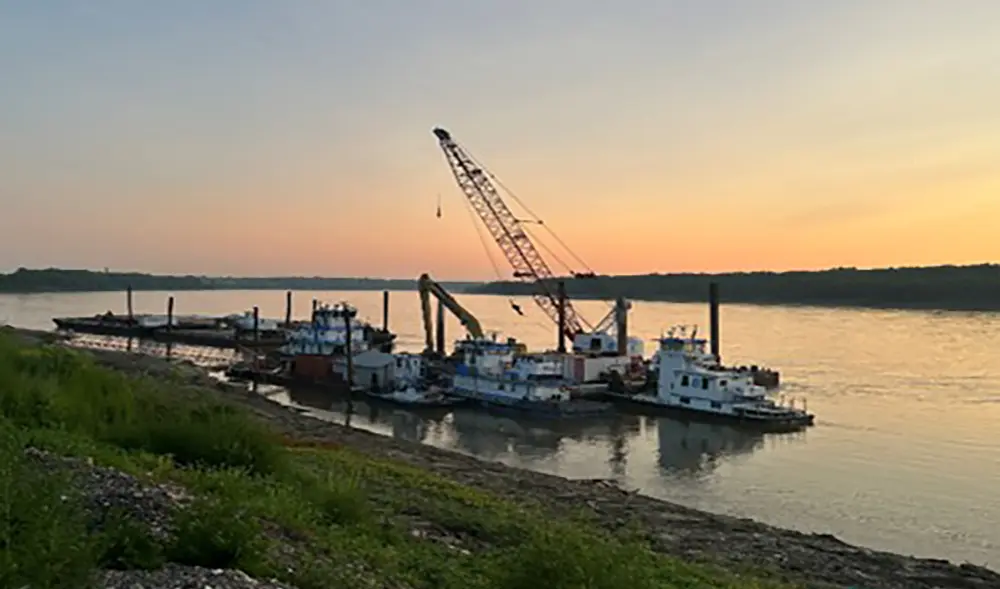
Brennan has treated more than 700 million gallons of water on the Kalamazoo River OU5 Area 4 Time-Critical Removal Action in Allegan, Michigan — more than on any other single project. The ongoing project addresses PCBs contamination within the Kalamazoo River Area of Concern (AOC).
This was one of the first remediation projects Brennan bid and won after acquiring IAI’s Dredging & Dewatering Division in 2023. In many ways, it is a quintessential Brennan water treatment project: PCBs-impacted sediment hydraulically dredged at more than 6,000 gpm, geotextile tube dewatering, separate processing of Toxic Substances Control Act (TSCA)- and non-TSCA-regulated sediments, and water treatment.

The People
From the beginning, our team approached water treatment for dredging projects much like domestic wastewater treatment. A wastewater plant has little control over the volume or quality of water entering the facility, and the flow never stops. Operators must treat the water hour by hour, day by day, reacting to conditions and adjusting processes to ensure the water returning to the environment is clean and safe.
Brennan’s water treatment operators work much the same way. They adapt to changing conditions, solve problems as they arise, and keep treatment moving alongside dredging and dewatering operations. Reaching five billion gallons reflects not only the water treated, but also the experience, adaptability, and dedication of the people behind the work.
When Brennan’s water treatment group reflected on the five-billion-gallon milestone, common themes emerged: pride in our work and teammates, confidence in the team’s collective expertise, and appreciation for our ability to adapt. Below, the people behind the milestone share what five billion gallons means to them.
Paul Stage, the only current Brennan employee who has been part of the dredging water treatment group since its inception in 2003, said, “I’m most proud of the talented and dedicated people on our team. They continue to learn from each project, solve difficult problems, and improve the way we design and perform our work every day.”
Brent Cardwell echoed this feeling, saying, “I am proud to work with experienced and talented water treatment coworkers.”
Jerry Bishop said, “Our greatest asset is the wealth of knowledge we have in-house to lean on when planning projects. It gives us the confidence to take on new challenges, knowing that when situations change, we can collectively find solutions that give the project team the best opportunity for success.”
Martijn Luth added, “What makes me most proud is how our water treatment capabilities have grown and how we are able to develop practical solutions for challenging projects. We don’t just rely on a standard treatment train; we use our field experience, treatability testing, and the different technologies we have available to determine what actually works.”
Greg Smith said, “I’m extremely proud of reaching this milestone. Collectively, we have built a team that can solve and execute the most complex projects in our industry. Five billion gallons is just the beginning.”
Connor McNeely said, “We do every task well, regardless of scale. We bring the same rigor and accountability to routine daily operations as we do to our most technically demanding projects.”
Bill Cretens, who retired from IAI’s daily operations before the acquisition, said he is “proud … incredibly proud” of reaching five billion gallons treated.
He credits the team for that success: “The water treatment group’s greatest strength is, without a doubt, the people. Their technical capabilities, combined with hands-on experience and a common-sense approach to projects, truly make them the best at this.”

Water Testing | Munger Landing – Duluth, MN
I believe our commitment to doing things right sets us apart. So many people contributed to this achievement. We can’t name them all here, but their hard work and sacrifices got us to this point. Today’s Brennan water treatment team honors their efforts by continuing to innovate, safeguard the water environment, and challenge the way things have always been done.
The measure of this milestone isn’t found in a certain number of gallons. It’s found in our team and what we can do together.
The meter will keep ticking …
About J.F. Brennan Company J.F. Brennan Company, Inc. (Brennan) is a family-owned marine construction firm specializing in environmental remediation, dam construction, commercial diving, harbor management, and submarine cable services. Working closely with public and private owners of water-based infrastructure since 1919, Brennan operates throughout waterways across the United States and Canada.