By Merril Collins
The discovery of golden mussels in California has quickly become more than an environmental story. For owners of dams, hydropower facilities, ports, industrial waterfronts, water treatment plants, and other critical water infrastructure, it represents a growing operational concern.
Like zebra and quagga mussels before, golden mussels rapidly colonize submerged structures, restricting water flow, increasing maintenance requirements, and making inspections more difficult. Most discussions focus on their ecological impacts; but infrastructure owners face a different challenge: how to identify risks early and prepare before infestations affect operations.
What Are Golden Mussels
Golden mussels (Limnoperna fortunei) are an invasive species originally native to Asia. They spread by attaching themselves to boats, equipment, and other underwater surfaces, allowing them to move quickly between connected waterways.
Once established, they reproduce quickly and form dense colonies on hard underwater surfaces. Their ability to attach to nearly any submerged structure and their ability to survive in not only fresh, but brackish waters, makes them a concern for facilities that depend on reliable water movement and access to underwater assets.
The recent detection of golden mussels in California has shifted the conversation for many infrastructure owners from “Could this happen here?” to “How prepared are we if it does?”

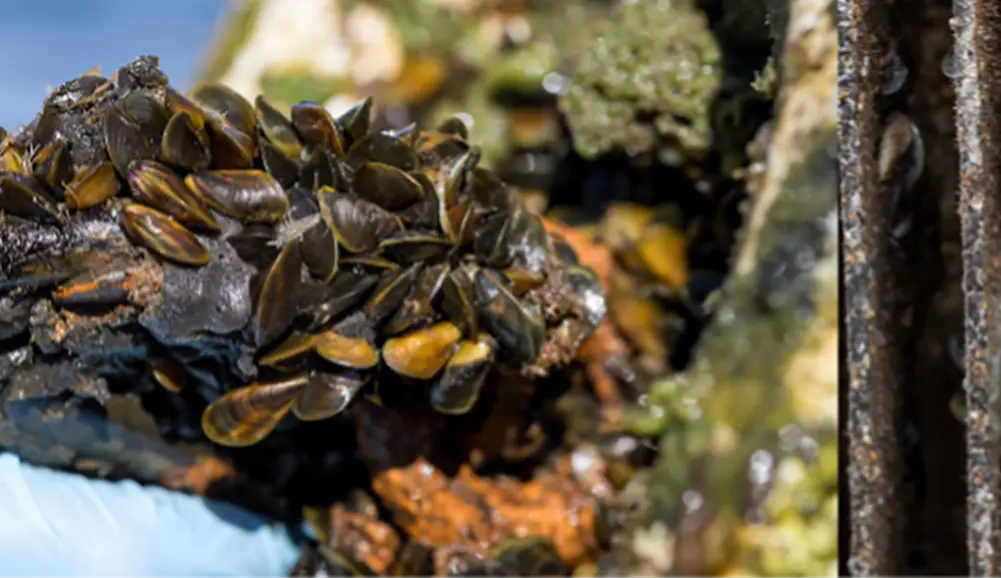
Example size of golden mussels. Photo source: CA Department of Water Resources
Why Infrastructure Is at Risk
Any water-based asset is susceptible to golden mussel colonization. Facilities that rely on continuous water flow or contain extensive underwater infrastructure may be particularly vulnerable.
Potentially affected infrastructure includes:
- Hydropower facilities
- Dams and spillways
- Water intake structures
- Cooling water systems
- Pump stations
- Navigation locks
- Ports and industrial waterfront facilities
- Water treatment plants
- Irrigation systems
- Pipelines and submerged conduits
As colonies grow, they restrict water flow, obstruct intake screens, increase head loss, complicate inspections, and accelerate maintenance needs. Left unmanaged, biological fouling can contribute to higher operating costs, unplanned maintenance outages, and reduced system performance.
Lessons Learned from Zebra and Quagga Mussels
North America has already seen how invasive mussels affect critical infrastructure. While golden mussels present their own challenges, decades of experience responding to zebra and quagga mussels have demonstrated one important lesson: early action matters.
Our infrastructure clients typically focus on:
- Establishing baseline conditions before problems develop
- Performing routine underwater inspections
- Monitoring high-risk assets
- Developing preventive maintenance plans
- Responding quickly when biological growth is detected

Golden Mussels attached to infrastructure. Photo: CA Department of Water Resources
How Infrastructure Owners Can Prepare
Waiting until mussels interfere with operations often limits available response options. Owners really should develop a proactive strategy that includes regular monitoring and underwater asset evaluations.
Key golden mussel preparation steps include:
- Assessing facility risk. Identify which underwater assets are most susceptible to colonization based on location, operating conditions, and water movement.
- Inspecting critical infrastructure. Intake structures, trash racks, gates, cooling water systems, and underwater mechanical components should be evaluated regularly to establish baseline conditions and identify early biological growth.
- Implementing monitoring programs. Comparing inspection results helps detect changes before they become operational problems.
- Developing maintenance plans. Identify an experienced marine contractor before issues arise to reduce downtime when maintenance or golden mussel eradication is required.
Why Underwater Inspections Matter
Most critical infrastructure cannot be fully evaluated from the surface. Commercial divers and remotely operated vehicles (ROVs) provide direct access to submerged assets, allowing owners to identify biological growth, verify structural conditions, document changes, and support engineering decisions.
Modern underwater imaging technologies, including high-definition video, imaging sonar, and detailed photography, create valuable records that owners can compare over time to monitor changing conditions.
Early inspections not only help identify invasive species, but they also improve overall asset management by giving owners a clearer understanding of infrastructure conditions.
Why Infrastructure Owners Trust Brennan for Underwater Infrastructure Management
Golden mussel management isn’t simply about removing biological growth. It requires understanding how invasive species interact with critical infrastructure, maintenance planning, environmental regulations, and the operational demands of facilities that cannot afford unexpected downtime.
That’s where Brennan provides a different perspective.
For more than 100 years, we’ve helped owners inspect, maintain, repair, and rehabilitate underwater infrastructure across North America. Our commercial diving, environmental, marine construction, and hydrographic survey professionals work together as one team, allowing clients to address multiple challenges through a single, trusted partner.

Owners rely on Brennan for:
- Commercial diving inspections performed by ADCI-certified, union-trained divers
- ROV inspections and advanced underwater imaging
- Hydrographic and condition surveys
- Water intake, trash rack, gate, and underwater asset inspections
- Biological fouling assessments and underwater cleaning
- Debris removal and maintenance support
- Golden mussel control/eradication
- Emergency response
What truly differentiates Brennan is our depth of experience.
Our commercial divers train through the United Brotherhood of Carpenter and Joiners as well as in our dedicated commercial dive training facility, preparing them to safely work in complex environments. Combined with our environmental specialists and marine construction professionals, our experience allows us to provide practical, safe, environmentally sound recommendations that support long-term asset performance.
We believe successful projects begin with collaboration. We partner with facility owners, consulting engineers, and regulatory agencies to develop inspection programs, prioritize maintenance activities, and create response strategies before invasive species begin affecting operations.
How Can Infrastructure Owners Move Forward
Golden mussels may be new to the western United States, but the importance of protecting critical water-based infrastructure is not. Proactive inspections, thoughtful maintenance planning, and strong partnerships have consistently proven to be the best defense against emerging challenges.
A practical tip: set consistent watercraft inspection rules and decontamination stations for vessels, commercial or recreational. This decreases exposure and risk of infestation.
For owners, preparing today will help avoid more costly and disruptive problems tomorrow.
We know that the best solutions begin with us understanding your infrastructure and working alongside stakeholders to develop practical, long-term strategies. Whether through underwater inspections, condition assessments, environmental expertise, or maintenance planning, our goal is simple: to help clients make informed decisions that protect their assets, support reliable operations, and keep critical infrastructure performing.
When it comes to protecting critical water infrastructure, the best outcomes are built on preparation, collaboration, and trusted partnerships.
About J.F. Brennan Company J.F. Brennan Company, Inc. (Brennan) is a family-owned marine construction firm specializing in environmental remediation, dam construction, commercial diving, harbor management, and submarine cable services. Working closely with public and private owners of water-based infrastructure since 1919, Brennan operates throughout waterways across the United States and Canada.